
Poa annua
Poa annua
Poa annua, commonly called annual bluegrass, is a cool-season grass that can form a putting surface or grow where another grass is wanted. On golf greens it may stand alone or share the surface with creeping bentgrass.12
 View full photograph
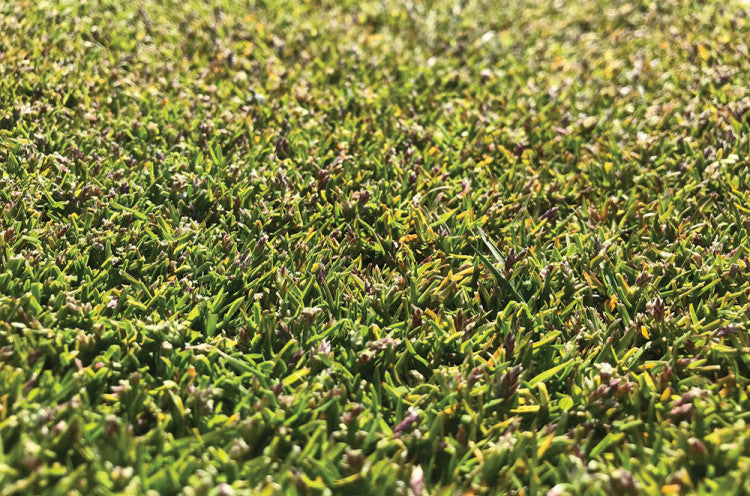
The common name does not describe every plant's life cycle. Penn State identifies short-lived perennial forms within this diverse species. Pale foliage and small, open seedheads help distinguish annual bluegrass from the surrounding turf.1
Golfers notice its seedheads because they can interrupt a smooth roll. The USGA also identifies tolerance of traffic and low light among its strengths, alongside vulnerability to heat, drought, disease and winter injury. The quality of a Poa green depends heavily on its climate and care.2
Maintaining a short plant and breeding a dependable seed crop are different problems. Penn State researcher David Huff began a putting-green breeding project in 1994. Promising dwarf lines repeatedly lost that form after generations of seed production without close mowing.3
In research reported by Penn State in 2021, inherited responses to mowing were associated with patterns of DNA methylation, a mechanism that can affect gene activity. The findings helped explain the breeding difficulty. They did not establish that a finished, stable commercial cultivar had resulted.3
At a glance
- Scientific name
- Poa annua1
- Growth category
- Cool-season grass2
- Character
- Dense putting turf that tolerates shade and traffic but is sensitive to environmental stress.2
- Putting surfaces
- Pure stands or mixtures with creeping bentgrass2
- Life cycle
- Includes short-lived perennial forms1
- Research milestone
- Penn State reported mowing-inheritance findings in 20213
Sources
- Penn State ExtensionWeed Management in Turf
- USGAPo-Uh-An-You-Uh Explained
- Penn State UniversityGolf course turfgrass species 'remembers' if it was mowed, develops differently